Scale as Strategic Advantage
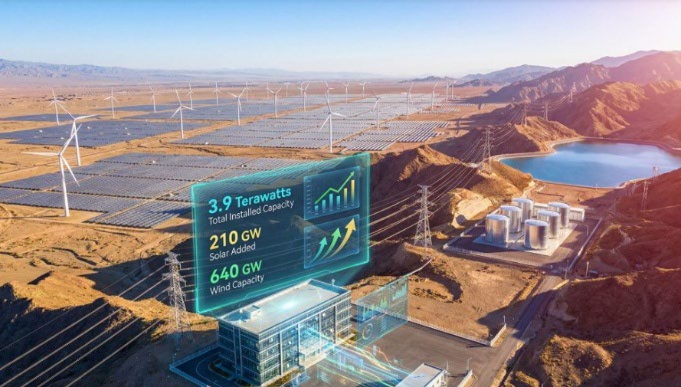
China’s total installed power generation capacity has reached approximately 3.9 terawatts, underscoring the scale of its energy infrastructure expansion and reinforcing its position as the world’s largest electricity system. The milestone reflects sustained multi-year investment across thermal, hydro, nuclear, wind, and solar assets, with renewable installations accounting for a growing share of incremental capacity. In absolute terms, the figure signals not only domestic energy sufficiency ambitions but also industrial-scale coordination that few economies can replicate.
Renewable Acceleration within a Dual-Track System
While coal-fired generation remains a structural pillar of China’s grid stability strategy, renewable capacity additions continue to outpace fossil fuel growth. Utility-scale solar farms, onshore and offshore wind installations, and ultra-high-voltage transmission corridors are being deployed at unprecedented speed. This dual-track model—maintaining dispatchable coal capacity while accelerating renewables—allows Beijing to balance decarbonization objectives with energy security and manufacturing competitiveness. The expansion supports power-intensive industries, including data centers, electric vehicle production, and advanced manufacturing clusters.
Infrastructure Depth and Global Competitive Implications
China’s energy scale-up carries global implications beyond electricity supply. Massive domestic capacity provides cost advantages for energy-intensive sectors such as aluminum smelting, battery production, and critical mineral processing. It also strengthens Beijing’s ability to export infrastructure expertise through engineering firms and state-backed financing. The strategic significance of 3.9 TW lies not merely in capacity volume, but in the integrated ecosystem it supports—an energy foundation that underpins industrial dominance and shapes competitive dynamics across global supply chains.
China, Energy & Infrastructure, Issue 36
China’s Installed Energy Capacity Reaches ~3.9 Terawatts