Grassroots Resistance Influences Permit Enforcement
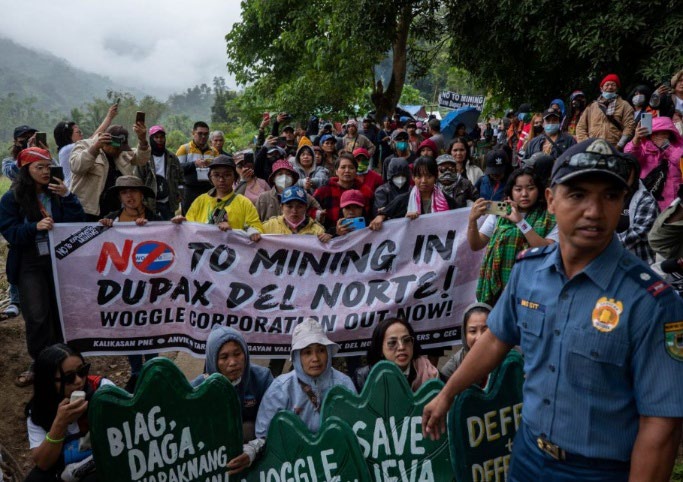
In Dupax del Norte, Nueva Vizcaya (Philippines), sustained community protests have directly influenced mining administration actions, resulting in the temporary suspension of Woggle Corporation’s exploration permit for gold and copper activities. Long-standing local resistance — encompassing road blockades, human barricades and petitions — escalated into public pressure that regulators acknowledged in citing force majeure as a basis for suspension, explicitly referencing the ongoing civil disturbance and blockades that made safe access and normal operations infeasible. The suspension, ordered by the Mines and Geosciences Bureau (MGB) under the Department of Environment and Natural Resources (DENR), demonstrates how collective grassroots mobilization and community dissent can shape regulatory outcomes in extractive contexts, especially where environmental concerns intersect with questions of public safety and consent.
Contestation over Free, Prior, and Informed Consent (FPIC) and Community
Rights Underlying the opposition is deep mistrust over how the exploration permit was obtained and whether legitimate Free, Prior, and Informed Consent (FPIC) was secured from Indigenous communities and local stakeholders. Protestors and allied environmental organizations allege that Woggle Corporation’s permit approval lacked meaningful consultation and that signature sheets from community meetings were improperly used to claim consent, igniting broader concerns about legitimacy and procedural integrity. These grievances reflect a recurring challenge in Philippine mining governance: balancing statutory permitting processes with authentic community engagement, particularly in areas with agricultural livelihoods, watershed functions, and cultural significance.
Strategic Impact on Local Governance and Regulatory Precedent
The permit suspension driven by stakeholder resistance has broader implications for mining governance and licence-to-operate dynamics in the region. Local environmentalist groups, church coalitions, and affected residents have not only pressured regulators but also called for legislative scrutiny, including Senate investigations into the permit’s issuance. The episode underscores that regulatory authorities increasingly face stakeholder expectations that extend beyond technical compliance to encompass social legitimacy, environmental protection, and procedural transparency. If sustained, this community-driven pause in exploration could establish a precedent whereby active mobilization affects formal permitting decisions, reinforcing the role of stakeholder participation in shaping mining project trajectories.
Issue 36, License to Operate (LTO) Conflicts
Philippines: Community Protest Leads to Suspension of Mining Permit in Dupax del Norte