
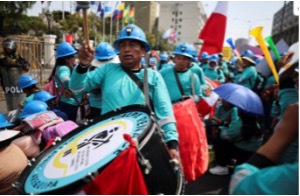
Regulatory Tension Erupts in Informal Mining Sector
In November 2025, more than 1,000 informal miners staged protests outside the legislature in Lima, pressuring Congress to extend the duration of the REINFO (Registro Integral de Formalización Minera) temporary-permit scheme until the end of 2027. These protesters argue that transitioning to full formalisation is overly complex and costly, while the government and formal mining companies warn that further extensions risk perpetuating illegal operations. The stand-off highlights the precarious balance between livelihoods, regulation and institutional credibility.
Licence to Operate Under Strain
At stake is not only individual mining permits but the broader “licence to operate” (LTO) environment for Peru’s mining sector. Formal-sector companies express concern that the continued extension of informal- permit regimes erodes regulatory certainty, raises cost risks and compromises competitive fairness. For the government, delays in formalisation reduce its capacity to enforce environmental, labour and safety standards in a sector already challenged by illegal operations and organised crime. The protest underscores how rushed or ambiguous transitions in informal mining can ripple across the entire supply chain.
Governance Implications and Pathways Forward
The protest reflects a governance dilemma: how to reconcile social stability, livelihoods and formal regulatory pathways without embedding a semi-legal status indefinitely. For Peru’s mining sector to strengthen its LTO profile, formalisation schemes like REINFO must deliver clear progression, support mechanisms and credible enforcement. Without that, the line between informal and illegal mining blurs, institutional risk increases and the value of licences—both large and small—can be undermined. This moment presents an opportunity for Peru to clarify its informal-mining policy, restore regulatory certainty and rebuild trust with all stakeholders.