
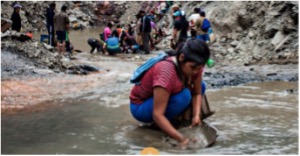
Title: Formalization of Artisanal and Small-Scale Mining in the Andean Region
Author/Institution: Cornelia Havel – Doctoral Dissertation, Alliance for Responsible Mining (with academic supervision)
Publication Year: 2017
Why Formalization Fails — and Why It Matters
Cornelia Havel’s dissertation is one of the most authoritative analyses of artisanal and small-scale mining (ASM) in the Andean region, with a particular focus on Peru, Bolivia and Colombia. Her work demonstrates that informality is not simply a legal status, but a structural condition rooted in poverty, weak institutions, fragmented territorial governance and the political economy of gold. Through fieldwork and institutional mapping, Havel shows how miners navigate a maze of inconsistent rules, temporary permits, overlapping concessions and predatory intermediaries—conditions that perpetuate informality and undermine both environmental governance and fair economic participation. Far from being marginal, ASM constitutes a central social and economic pillar in many regions yet remains trapped outside the rule of law.
The Politics of Formalization: Barriers More Social Than Technical
Methodologically, the thesis combines socio-legal analysis, environmental assessments and interviews with miners, regulators and local authorities. Havel argues that most formalization programs—such as Peru’s REINFO system—fail because they are designed as bureaucratic compliance exercises, not developmental pathways. Paper-based regularization processes ignore miners’ real constraints: lack of geological data, limited capital, insecure land tenure, predatory financiers, and in some cases, criminal networks. The study exposes how temporary-permit regimes can become political bargaining tools rather than strategies for sustainable governance. It also highlights the tension between “merely legalizing” miners and actually integrating them into safer, cleaner and economically viable production systems.
Implications for Governance, Conflict and the Energy-Transition Era
Havel concludes that meaningful formalization requires far more than registering miners—it requires integrated policy architecture: technical assistance, financial instruments, environmental support, market access, and secure, conflict-free territorial rights. Her analysis is directly relevant to today’s headlines across Peru and the wider Andean region: protests over REINFO, clashes with environmental authorities, and the weakening of the social license of formal mining companies due to regulatory ambiguity.