
From Vulnerability to Strategic Coordination
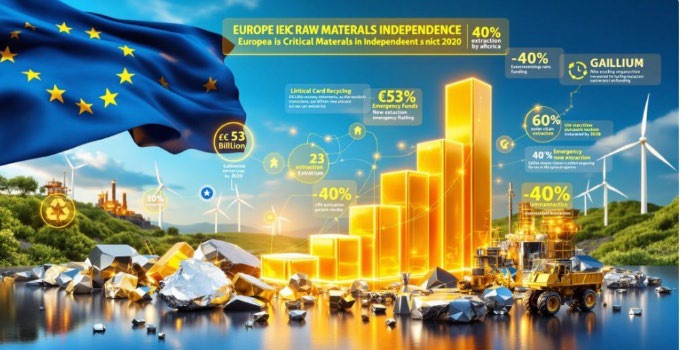
On November 28, 2025, the European Union signaled the imminent launch of ResourceEU, a policy framework designed to reduce the bloc’s dependence on external suppliers—particularly China—for critical raw materials. The initiative reflects mounting concern within European institutions that concentrated supply chains expose industry, energy transition goals, and economic security to heightened geopolitical risk. ResourceEU is framed as a coordinated response that moves beyond ad hoc measures toward a more integrated raw-materials strategy.
Priority Projects, Processing, and Circularity
ResourceEU is expected to focus on a portfolio of priority mining, processing, and recycling projects across member states and partner countries. Rather than seeking self-sufficiency at all costs, the plan emphasizes diversification of sourcing, expansion of domestic and regional processing capacity, and stronger recycling and substitution efforts. This marks a shift in EU industrial policy: raw materials are increasingly approached as strategic enablers of manufacturing, clean-energy systems, and technological sovereignty.
Why ResourceEU Matters for Global Mineral Markets
The EU’s move reinforces a broader global pattern in which major economies are re-embedding minerals into industrial and trade strategy. For producing countries, ResourceEU signals sustained long-term demand—but also rising expectations around reliability, transparency, and sustainability. For investors, it underscores that future mineral value chains will be shaped as much by policy alignment and geopolitical positioning as by resource availability. In this sense, ResourceEU is less about decoupling and more about recalibrating partnerships in an increasingly competitive critical-minerals landscape.