
The Case:
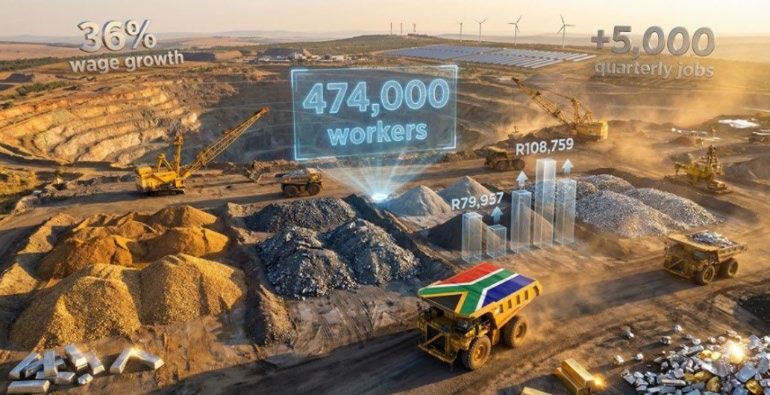
In 2025, South Africa illustrated how long- standing institutional strain can undermine even mature extractive economies. Despite deep mining experience, sophisticated regulatory frameworks, and global market integration, South Africa’s performance was increasingly constrained by systemic fatigue— manifesting across energy supply, infrastructure reliability, and governance coordination. Rather than a crisis of resources, the challenge was one of institutional endurance: the ability to maintain functionality across interconnected systems under sustained pressure.
The Facts:
At the beginning of 2025, mining operations continued to face disruptions linked to energy instability, logistics bottlenecks, and rising operating costs. While reform efforts in the power sector progressed incrementally, reliability remained uneven, directly affecting production continuity and investment confidence.
By mid-year, attention shifted to the cumulative impact of governance strain. Infrastructure maintenance backlogs, regulatory complexity, and capacity constraints within public entities slowed project approvals and execution. Industry and labor tensions resurfaced intermittently, reinforcing uncertainty around operational predictability.
In the second half of the year, policy signals emphasized reform and stabilization, but delivery lagged expectations. While South Africa retained its role as a major producer of key minerals, including platinum group metals and manganese, its comparative advantage eroded at the margins. By December, the narrative was clear: output persisted, but institutional stress limited momentum.
Why This Case Was Important in 2025
South Africa mattered in 2025 because it demonstrated that governance fatigue can be as constraining as resource scarcity. Unlike frontier jurisdictions, South Africa’s challenges did not stem from weak frameworks, but from the difficulty of sustaining performance across energy, infrastructure, and regulatory systems simultaneously. The case also highlighted a broader risk for established producers: when reform efforts advance more slowly than system degradation, credibility erodes even in the absence of acute crisis. South Africa showed that resilience depends not only on reform intent, but on the capacity to execute consistently over time.