
From Resource Dominance to Industrial Opportunity
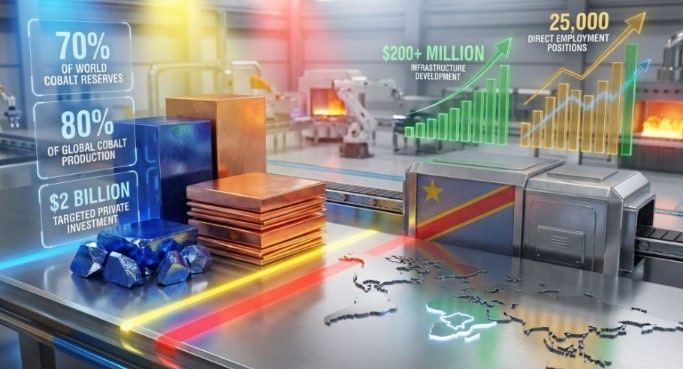
The Democratic Republic of Congo (DRC) occupies a strategic position in the global energy transition due to its extraordinary mineral endowment, particularly cobalt. The country holds more than two-thirds of the world’s known cobalt reserves and produces over 80% of global supply, primarily from operations concentrated in the Central African Copperbelt. This geological advantage extends beyond cobalt to include significant copper deposits and emerging lithium prospects, positioning the DRC as a potential cornerstone in the global battery minerals ecosystem.
Industrialization Through Processing and Special Economic Zones
Government initiatives increasingly aim to move beyond the export of raw minerals toward domestic value addition. The Musompo Special Economic Zone in Lualaba province represents one of the most ambitious efforts to develop integrated processing capacity for battery minerals, potentially including cobalt refining, precursor materials, and components used in battery manufacturing. By expanding local processing capabilities, policymakers hope to capture greater economic value from mineral resources while strengthening the country’s role within global supply chains linked to electric vehicles and energy storage technologies.
Implementation Challenges and Strategic Partnerships
Despite strong geological advantages, building a full battery mineral value chain presents significant institutional, financial, and infrastructure challenges. Power supply constraints, transportation limitations, and the need for advanced processing technologies remain major barriers to industrial expansion. At the same time, international partnerships, particularly with development agencies and global market actors—are becoming essential to support technology transfer, investment mobilization, and compliance with international environmental and traceability standards. The success of these initiatives will ultimately depend on the country’s ability to align governance, infrastructure development, and industrial policy within a coherent long-term strategy.