
Written by Loren Stoddard.
Executive Summary
Stakeholder risk is credit risk. When a mine’s relationship with the people who live around it breaks, the cost doesn’t land in a CSR report. It lands on the balance sheet, as stranded assets, delayed production, a higher cost of capital, costlier insurance, and, as Panama learned, sovereign downgrades. The problem isn’t that this risk is soft. The problem is that no instrument prices it before it breaks.
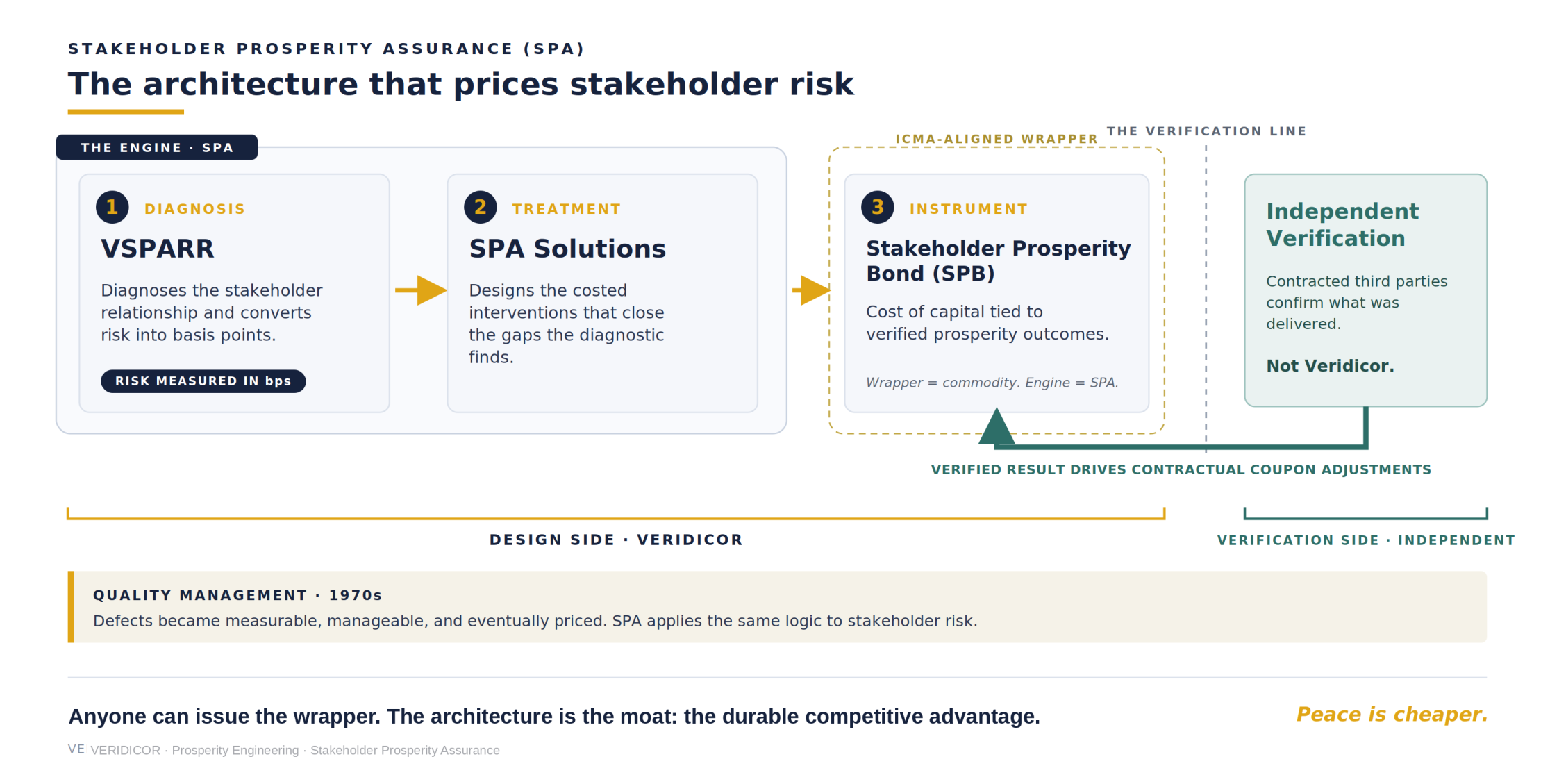
This letter sets out the architecture built to price that risk. The architecture is Stakeholder Prosperity Assurance, or SPA. It has three parts. VSPARR, the Veridicor Stakeholder Prosperity Assurance Risk Review, is the diagnostic that translates stakeholder risk into basis points. SPA Solutions is the intervention design that closes the gaps the diagnostic finds. The Stakeholder Prosperity Bond, or SPB, is the debt instrument designed to link the cost of capital to prosperity outcomes that are verified independently.
SPA isn’t philanthropy, community relations, or ESG marketing. It’s risk management, credit enhancement, and financing architecture, built for one objective: preserving enterprise value by pricing and reducing stakeholder-related credit risk. Anyone can issue a labeled bond. The label is a commodity. The architecture is not. Peace is cheaper, and the rest of this letter is the evidence for it.
I. The Cascade
On the morning of November 28, 2023, Panama’s Supreme Court ruled the contract governing Cobre Panamá unconstitutional, and one of the largest copper mines on Earth went dark. By the end of that month, First Quantum Minerals had placed a roughly $10 billion asset, the largest private investment in Panama’s history, into what the company politely calls “Preservation and Safe Management.” Translation: the lights are on, the gates are locked, and nothing is being mined.
I want you to sit with the cascade, because the cascade is the lesson.
First Quantum reported a net loss attributable to shareholders of $954 million for 2023, with a $1.45 billion loss in the fourth quarter alone. Its streaming partner, Franco-Nevada, wrote its Cobre Panamá interest down to nil, recognizing an impairment of $1.169 billion. First Quantum filed arbitration against the Republic of Panama seeking at least $20 billion, then at the end of March 2025 discontinued one proceeding and suspended the other as a precondition for even talking about a restart. First Quantum’s shares, which had traded in the high-30s to around $40 Canadian in mid-2023, fell to roughly $11 by December, a decline on the order of 70 percent. Panama itself was downgraded; Fitch cut the sovereign to BB+ from BBB- on March 28, 2024, ending the investment-grade status the country had held since 2010 and citing a mine closure that represented about 5 percent of GDP and 7 percent of current external receipts. S&P, in its November 2024 downgrade, warned that potential liabilities from the arbitration could reach as much as 20 percent of Panama’s GDP.
Now here is the part that matters for everyone reading this. Cobre Panamá was not stopped by a geological surprise. It was not stopped by a copper price collapse, by a tailings failure, or by a flooded decline. It was stopped by 39 days of protest, a court that struck the contract down as unconstitutional, and a government that then ordered the mine wound down. The asset is intact. The orebody is world-class. The cash flows were real: pre-shutdown, Cobre Panamá supplied about 40 percent of First Quantum’s revenue, roughly 1 percent of the world’s mined copper, and around 5 percent of Panama’s GDP. What failed was not the mine. The protests fixed on real things, a protected coastal forest, the water, a contract many Panamanians felt was struck over their heads. But underneath every one of those grievances sat the same structural absence: no financial instrument had priced the relationship between the mine and the people who live around it before it broke.
That is the number I want you to feel: $10 billion of stranded copper, idled not by rock but by trust.
I am writing this in mid-2026, six months into a series called the SPA Letter, because the framework I am about to describe needs a public record, in plain language, of what it is and what it is not.
II. The Pattern
Cobre Panamá is not an outlier. It is the most expensive recent instance of a pattern that anyone who has financed, insured, or operated a mine already knows in their gut.
Conga, in Peru, was a $4.8 billion gold-and-copper project that Newmont effectively shelved after sustained community opposition over water. While the project sat suspended, the carrying cost ran to roughly $2 million a day. Pascua-Lama, on the Chile-Argentina border, became one of the most expensive holes never fully dug: Barrick took billions in writedowns, the project’s cost estimates ballooned from around $3 billion to north of $8 billion, and a Chilean court ordered a halt over environmental and community obligations. Oyu Tolgoi, in Mongolia, saw its underground budget swell to $6.75 billion amid a protracted dispute with the state, and in 2025 Rio Tinto agreed to pay $138.75 million to settle a US shareholder class action over the project. Kumtor, in the Kyrgyz Republic, ended with a $3.1 billion environmental fine and the state seizing the mine outright. Didipio, in the Philippines, sat under a suspension for nearly two years before resuming, with OceanaGold ultimately agreeing to enhanced local benefit-sharing as part of the path to restart. Bibiani, in Ghana, saw a $105 million sale to Chifeng collapse when the government intervened over ownership and local commitments.
The practitioners who study this have tried to put a unit price on it. Daniel Franks, Rachel Davis, and their co-authors, in a 2014 paper in the Proceedings of the National Academy of Sciences that ought to be on every mining CFO’s desk, documented a world-class project with capital expenditure between US$3 and US$5 billion that suffered roughly US$20 million per week of delayed production in net present value terms, and a single company whose internal analysis revealed US$6 billion in conflict-related costs over two years, representing a double-digit percentage of its annual operating profit. The lesson is not that communities are obstacles. The lesson is that the relationship is an asset, and an unpriced asset is a mispriced asset.
The pattern shows up in the same column of the same spreadsheet every time. Conga: $2 million a day of carrying cost while the project sat. Cobre Panamá: roughly $10 billion of stranded asset, idled by relationship, not by ore. Pascua-Lama: about $5 billion in writedowns and a court-ordered closure. Kumtor: the mine itself, lost to seizure. Didipio: nearly two years of foregone production. These are not soft costs. They are the hardest costs there are, and they are all examples of stakeholder risk being priced after failure rather than before failure. Manufacturing once treated quality the way mining treats stakeholder prosperity today, as important but not central. History suggests that view will not survive.
III. The Architecture
Here is what I have spent the last several years building, and what the SPA Letter exists to explain.
SPA stands for Stakeholder Prosperity Assurance. It is an architecture with three load-bearing parts, and the parts matter in order.
The first part is diagnosis. VSPARR, the Veridicor Stakeholder Prosperity Assurance Risk Review, is a structured diagnostic. It decomposes the stakeholder relationship into three layers. The first layer is the stakeholder conditions themselves, from distribution legitimacy and livelihood base to voice and historical legitimacy. The second is the operating-environment conditions that carry stakeholder pressure into capital consequence, from the credibility of the state as a counterparty to the asset’s exposure inside the capital structure. The third is the conditioning regimes that govern how both read, including capital-sovereign coupling and regulatory conditioning. The methodology is versioned under v7.8.5, a deliberately unglamorous way of saying it is documented and reproducible rather than improvised per engagement. VSPARR is designed to translate stakeholder risk into basis points, rather than a letter grade. That design choice is the whole point. A grade tells you a mine is “medium risk.” A number in basis points tells you what that risk costs, in the only language the capital structure actually reads.
The second part is treatment. SPA Solutions is the intervention design layer. Once VSPARR locates where the relationship is thin, SPA Solutions designs the specific, costed interventions that thicken it: offtake that includes local miners, grievance mechanisms that actually resolve grievances, benefit-sharing that communities can see and verify. This is the doctor-to-patient part of the work. A diagnosis without a treatment plan is just an unusually precise way to worry.
The third part is the instrument. The Stakeholder Prosperity Bond is designed to link the cost of capital to prosperity outcomes that are verified independently, by contracted third parties rather than by VSPARR. It is a debt instrument whose pricing is linked to predefined social and environmental results for workers, communities, and host economies, with an industrial anchor at the center of the structure to support repayment. If those outcomes are delivered, the economics reflect it. If they are not, the economics reflect that too. VSPARR sits on the design side of that line, not the verification side: it is how the risk gets diagnosed, the interventions shaped, and delivery tracked, while whether the bond pays or steps up is decided by independent verification, not by our own diagnostic.
Many competent treasury teams can now issue an ICMA-aligned bond. That is a commodity skill in the best sense, widely available, well-documented, professionally executed. What is not yet a commodity skill is SPA, because SPA is not a label. It is a diagnosis, a treatment, and a price, fastened together. The wrapper says a bond is sustainable. The architecture says what the relationship is worth, and the financing terms reflect it accordingly.
Peace is cheaper. That is not a slogan. It is a pricing claim, and the rest of this letter is the evidence for it.
IV. What the Label Market Got Wrong
If the architecture is the answer, it is worth being precise about why the existing answer, the labeled-bond market, has underdelivered.
The labeled sustainable bond market is enormous. Cumulative issuance of green, social, sustainability, and sustainability-linked bonds has passed the multi-trillion-dollar mark, and the ICMA Principles are now referenced by over 98 percent of that issuance. And yet the part of that market that was supposed to tie money to outcomes, the sustainability-linked bond, has largely failed to bite. The standard structure attaches a coupon step-up of around 25 basis points if the issuer misses its targets. That structure has drawn sustained criticism, much of it pointing at the same flaw: issuers were largely left to grade their own homework, and the early sustainability-linked market earned a reputation for thin discipline. The targets are frequently self-determined, set late, and calibrated to be met. Most of the key performance indicators have clustered around Scope 1 and 2 emissions, with social indicators a rounding error by comparison. SLB volumes have fallen to a small fraction of sustainable issuance.
The diagnosis is not that the people who built that market acted in bad faith. The diagnosis is structural. The wrapper was there. The architecture was not. A 25-basis-point step-up that triggers on a target you set yourself is not a price signal. It is a gesture. The Stakeholder Prosperity Bond exists precisely because the lesson of the SLB market is that the link between money and outcome has to be real, material, and independently checked, or it is theater.
V. The Warranty Claim Is Already Being Paid
If stakeholder risk were not real and financial, the political risk insurance market would not exist. But it does exist, and it pays.
The members of the Berne Union, the global association of export credit and investment insurers, pay claims year after year for exactly the kind of event that idled Cobre Panamá. Pre-claims notifications rose through the early 2020s. MIGA, the World Bank’s political risk arm, had by the middle of 2021 paid a series of claims, most of them for war and civil disturbance, the rest for expropriation. Demand for political risk cover has climbed sharply: Willis Towers Watson’s sixth annual Political Risk Survey found that 68 percent of surveyed companies now purchase political risk insurance, compared with 25 percent in 2019, and that 92 percent of respondents experienced a political risk loss in 2022, up from 35 percent in 2020.
Here is the way to think about that market in relation to SPA. Political risk insurance is the warranty claim, not the quality system. It pays out after the relationship has already broken. SPA is the quality system: the thing that reduces the probability of the claim in the first place. A world that buys ever more political risk insurance while doing nothing to price and repair the underlying relationship is a world paying rising premiums on a risk it refuses to manage at the source.
VI. The Lesson Quality Already Taught Us
The real question is whether stakeholder prosperity is merely another ESG idea, or whether it belongs in the same category as quality management itself. History offers a test. I have seen this movie before, and so has every reader who knows the history of manufacturing.
In the decades after the Second World War, W. Edwards Deming took a set of ideas about quality to an industry that would listen. American manufacturers, then dominant, largely did not. Deming’s 14 Points and his book “Out of the Crisis,” along with Joseph Juran’s teaching and Philip Crosby’s “Quality Is Free,” argued that quality was not a cost center to be minimized but a discipline that paid for itself through lower failure costs. Crosby gave the waste a name: the price of nonconformance, the money a firm burns building things wrong. SPA carries the same accountant’s logic. The basis points the market charges when stakeholder prosperity is not credibly verified are a Verification Premium, the price of nonconformance for the relationship, and the wager of this whole framework is that the cost of building the architecture comes in below it. Detroit, through the 1960s and 1970s, treated this as soft. The Toyota Production System treated it as gospel. Shoichiro Toyoda said plainly that “Deming is the core of our management.”
The result is history. When Toyota launched Lexus in 1989, it went directly at Cadillac and, within a short span, J.D. Power ranked Lexus first. Toyota’s operating discipline showed up in operating margins that ran well ahead of its Detroit rivals. Quality moved from novel, to soft, to table stakes. The firms that internalized it early did not just avoid defects. They earned a structural advantage that took competitors decades to close.
I have spent my own career on the relationship side of hard places, and one of the clearest examples came in Peru’s Huallaga Valley.
When I first began working there, the region was known for coca, trafficking, and the remnants of Shining Path. The prevailing assumption was that security would solve the problem. Security mattered, but it was not enough. Over the next several years, a coordinated effort of U.S. and Peruvian agencies, local governments, cooperatives, and thousands of farming families built a legal economy around cacao, coffee, roads, and market access. Organizations like Acopagro grew from a few dozen farmers into thousands. Poverty fell dramatically. Cacao and coffee replaced coca across large parts of the region. In February 2012, Florindo Flores Hala, known as Artemio, the last major Shining Path commander in the Huallaga, was captured at the end of a period in which legal economies, security pressure, and local institutions had steadily reduced the space in which his movement operated.
The lesson was not that cacao defeated terrorism. The lesson was that prosperity changed the incentive structure. Security created space. Prosperity filled it.
I have never forgotten that. It is one of the reasons I believe stakeholder prosperity is not philanthropy. It is infrastructure. Stakeholder prosperity is, right now, where quality was in the 1970s: dismissed by incumbents as soft, treated by a few as the core of management, and about to become table stakes. The only question is who internalizes it before it is priced for everyone.
VII. Governance: The Moat Behind the Moat
A diagnostic is only as credible as the institution that governs it. This is the part of the doctrine that the first version of this argument left implicit, and it is too important to leave implicit, so let me be direct, including about my own firm.
VSPARR is, today, Veridicor’s diagnostic. It is our intellectual property, built from our methodology, scored by our people. I want to say that plainly because candor here is the whole point. That is not a weakness to be hidden. It is the same place every market-standard analytical framework on Earth started. Moody’s began as one man’s opinion about railroad bonds. SASB began as one organization’s standards. The TCFD began as a task force. IRMA began as a coalition. Every one of them started as somebody’s product.
The path from proprietary product to market authority is well worn, and it runs through governance: transparent methodology, independent co-governance, third-party audit, and eventually regulatory recognition. Consider the precedents, because they are the map.
Credit ratings themselves made this journey. For most of the twentieth century, an agency’s rating was a private opinion the market happened to trust. It became regulated infrastructure only when the Credit Rating Agency Reform Act of 2006 required agencies to register with the SEC, disclose their methodologies, and submit to oversight. Recognition, not reputation, is what turned opinion into infrastructure.
The sustainability-standards world ran the same play, faster. SASB, the TCFD, and the GRI each began as a private body or a task force, and each moved within a decade into public, multi-stakeholder due process, most of it now housed under the IFRS Foundation. Private product became public standard through governance.
The closest precedents sit nearest to what SPA does. ICMA’s own bond Principles, the label architecture I called a commodity earlier, became the de facto standard precisely because ICMA governs them through an open, member-refreshed committee rather than as one bank’s house style.
The most relevant precedent of all sits in our own industry: IRMA, the Initiative for Responsible Mining Assurance. IRMA is governed by a board with two voting seats and equal authority for each of six sectors: mining companies, the firms that buy minerals, investors and finance, affected communities and Indigenous rights-holders, organized labor, and environmental and human-rights NGOs. No single sector can ram a decision through, and any two “no” votes from one sector can block it. That is co-governance with teeth, and it is the reason buyers and investors treat IRMA’s site-level audits as credible.
So here is the thesis, stated as plainly as I can. VSPARR’s future as market infrastructure depends on co-governance the same way Moody’s future as market infrastructure depended on NRSRO recognition. SPA needs assurance at two levels, not one. At the project level, the question is whether the prosperity outcome was actually delivered, the measurement question the Verification Gap names, and it is answered by contracted third parties rather than by us. At the methodology level, the question is whether the diagnostic itself is trustworthy, and that is a question of governance. Both matter. The project moat is the obvious one. The governance moat sits behind it.
Let me name Veridicor’s intent on the record, since that is what this letter is for. We intend to move VSPARR toward independent co-governance as the next phase of its development. We do not intend to hold the methodology privately forever. A diagnostic that stays proprietary stays informative. A diagnostic that is independently governed becomes authoritative. We are building for the second outcome.
VIII. Why Ratings Describe But Do Not Bind
It is worth being clear about why the existing measurement industry, ESG ratings, has not solved this, because the answer points directly at what SPA does differently.
The foundational problem is that ESG ratings disagree with each other. Berg, Kölbel, and Rigobon, in their study “Aggregate Confusion,” published in the Review of Finance in 2022, found that ratings from the major providers correlate on average around 0.61, with the pairwise range running from 38 percent to 71 percent across six agencies. To translate: two reputable agencies looking at the same company frequently reach materially different conclusions. As the authors put it, the dispersion rarely produces diametrically opposed verdicts, but it is wide enough that telling the leaders from the average performers becomes difficult, on the same company, at the same time.
And to be clear, the agencies do not dispute that the underlying risk is real. S&P’s own general criteria name “social capital,” the impact of social unrest on growth and budgetary prospects, as a credit factor. Fitch has published research under the blunt title that social risks can be credit risks, and has noted that ongoing social conflict in Peru led it to review the ESG relevance scores of rated metals and mining companies. The agencies already concede the thesis of this letter. What they have not built is consequence.
Because disagreement is the smaller problem. The larger one is structural, and it is true even where the ratings agree. ESG ratings describe; they do not bind. They produce a score that sits beside the security without changing a single cash flow inside it. They are diagnoses without covenants. A low score embarrasses; it does not cost. And a measurement that generates information without consequence will, predictably, generate a great deal of information and very little consequence.
SPA’s answer is not to publish a better score. It is to write the prosperity outcome into the covenant and let an independent verifier, not Veridicor, confirm whether it was delivered, so that the verified result feeds directly into the cost of capital under the terms of the bond. That is the difference between a rating and a price.
IX. What This Means If You Allocate Capital
Let me speak directly to the people who will decide whether any of this matters, because the implication is different for each seat at the table.
If you are a mining CFO, the stakeholder line is mispriced on your own books right now. You carry it, if you carry it at all, as community relations expense or social investment, a cost to be minimized. The cases in Section II say it is nothing of the kind. It may be one of the largest sources of stranded-asset risk you hold, and you are accounting for it as charity. Price it as risk, and the math for prevention changes completely.
If you are a DFI investment officer, there is now a live pilot to point to, pre-close but real. Veridicor and Metalex Commodities, a Zambian copper producer, are piloting a Stakeholder Prosperity Bond that integrates artisanal and small-scale miners into a formal supply chain anchored by an industrial mine. International Finance Magazine called it Africa’s first stakeholder prosperity bond, and Reuters reported the pilot independently in April 2026. The structure is what DFIs have been asking for in theory: returns linked to verified social and environmental outcomes, with an industrial counterparty underwriting repayment.
If you are a sovereign debt advisor, read the Panama downgrade as the clearest possible warning. What happened there was stakeholder risk migrating onto the sovereign balance sheet. A company’s broken relationship with 39 days of protest became a fiscal hole, an arbitration overhang, and a junk rating. Stakeholder risk does not stay at the project level. It climbs the capital structure until it reaches you.
And if you are a bond investor, here is the reframing. The greenium debates of the last decade were arguments about a few basis points of sentiment, whether a green label shaves a sliver off the yield. This is not that. This is whether the mine runs or does not run. The difference between a priced stakeholder relationship and an unpriced one is not a few basis points of greenium. It is the difference between coupons that arrive and an asset in Preservation and Safe Management.
X. The Lineage
I want to be honest about where this idea comes from, because doctrine without lineage is just branding.
The phrase “social license to operate” was coined by a practitioner, not an academic. Jim Cooney, then at Placer Dome, used it at a World Bank gathering in 1997 to describe the difference between the legal permit to mine and the community’s actual acceptance of the mine. Researchers like Thomson and Boutilier later built the concept out into something you could study and stage. That is the usual order of operations. Practitioners name the thing. The institutions carry it.
Stakeholder Prosperity Assurance is the next turn of that same wheel. It takes the intuition behind social license, that the relationship is real and consequential, and does the thing the concept was always missing: it attaches a number, a treatment, and a price. The same path that carried social license from a practitioner’s phrase into the standard vocabulary of the industry is open here. That is exactly the path Section VII described, and it is the path we intend to walk.
XI. A Young Architecture, Written Down
Let me end with the concession that matters most, because a doctrine that oversells itself is not worth citing.
This is a young architecture. The Zambia bond is one issuance, not 25. The pipeline is in development. I am not claiming that stakeholder prosperity bonds are an established asset class with a decade of spread data behind them, because they are not, and you would be right to discount anyone who told you otherwise. The case for SPA at this moment is structural, not statistical. It rests on the logic of the cases, the failure of the label market, the persistence of the political risk market, and the historical pattern of quality, not on a track record that does not yet exist.
That is precisely why I am writing it down. This letter is the public record of what the framework is, as of mid-2026, in the author’s own words. I am writing it down so that the next 24 issuances, whoever structures them, can argue with this version of the doctrine rather than guess at it.
So here is the doctrine, compressed. Stakeholder risk is credit risk. The wrapper is a commodity. The architecture is the moat. Governance is the moat behind the moat. VSPARR seeks to measure stakeholder risk in basis points. SPA Solutions seeks to reduce it. The Stakeholder Prosperity Bond seeks to embed the outcome in the cost of capital.
Peace is cheaper. The work is to prove it issuance by issuance, in basis points the market can read.
linkedin article