
Written by Loren Stoddard.
THE SPA LETTER · No. 5 · LOREN STODDARD
Cacao beat coca. Then it beat gold. Then Peru beat the world. The difference was never the money.
A chocolate bar can teach a bond investor something that decades of mining reports did not.
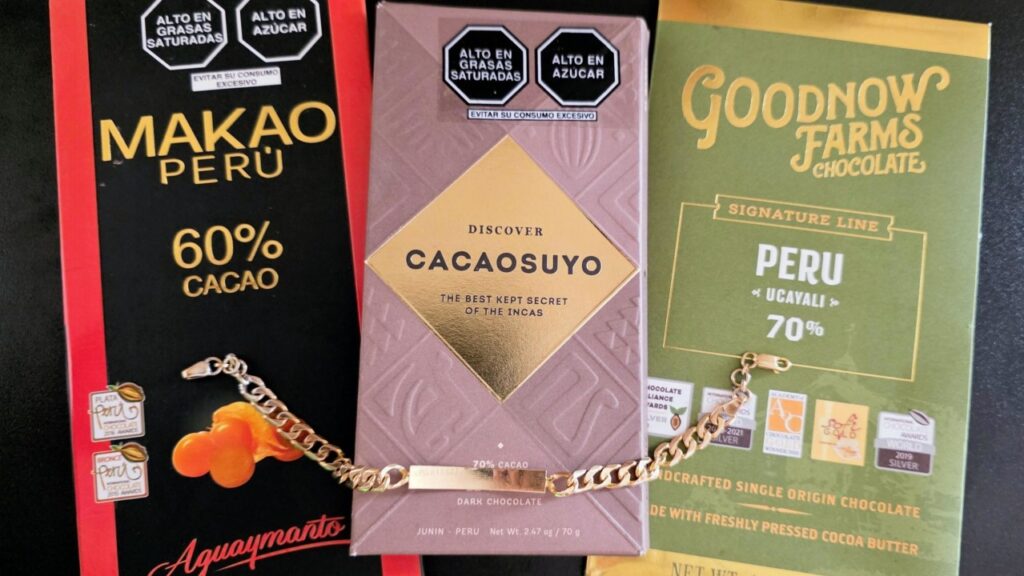
The bar is made in Tocache, in the San Martín region of Peru, and it carries four independently verified claims on its wrapper. Organic. Fair trade. A certified origin. A traceable cooperative. Each of those seals was placed there by somebody who does not work for the people who grew the cacao, and each one moves a price. Buyers in Europe pay more for the beans behind that bar than for anonymous ones, and they pay more for a reason a bond investor recognizes on sight: the claims have been checked.
Everyone knows Peru has gold. Almost nobody knows Peru has chocolate. In November, at the world final of the International Chocolate Awards in Florence, a Peruvian bar… not the one from Tocache, a different one, from the jungle of Junín… was named the best chocolate on Earth, chosen blind from more than 3,500 entries. That is how deep the bench runs now. The gold has been famous for five centuries. The chocolate took thirty years, and much of it grew out of valleys that first had to be taken back from coca.
Six hundred kilometers to the west sits one of the largest gold operations in Latin America. It has carried permits by the dozen, environmental audits by the hundred, monitoring programs, community reports, and two decades of corporate social responsibility spending. Not one of those documents is a verified claim about whether the people next to the mine got richer. They describe conduct. They do not price performance.
Fifty kilometers from that mine are households in the poorest department in Peru.
The difference between those two wrappers… the seals on the chocolate and the paper around the mine… is the whole of this Letter. It is the cleanest real-world comparison I know of in what actually converts resource wealth into prosperity. The answer is not the resource. It is not the money. The money, if anything, ran the other way.
One note on who I am writing to, before anything else. Not everyone. This Letter is for the people trying to finance critical minerals without financing the next shutdown: the OEM buyer in an IRMA room trying to secure responsible supply without buying tomorrow’s scandal; the equity or debt investor looking at copper, tungsten, lithium, gold, or rare earths and asking whether the asset will actually stay open; the development-finance officer trying to make a mining-linked bond bankable; and the funder deciding whether a Zambia aggregation model is investable.
For that reader, this is not a nostalgia piece about cacao. It is a warning label for critical minerals. The world is trying to build clean-energy and defense supply chains in places where permits do not equal permission, budgets do not equal prosperity, and reports do not equal verified outcomes. Peru already ran the experiment, at regional scale, over twenty years. One valley converted. One valley did not.
This is the fifth Letter, and the one that gathers the other four. The weekly cost of a broken relationship in The $20 Million Per Week Problem, the collapse of the aid buffer in The $50 Billion Vacuum, the missing measurement layer in The Verification Gap, and the pricing logic of Peace Is Cheaper… all four show up at once in two valleys of northern Peru, with a twenty-year time series and a hard comparator built in.
Stakeholder Prosperity Assurance: a diagnostic that translates stakeholder risk into basis points, a design layer that closes the gaps it finds, and a bond whose cost of capital is tied to outcomes an independent party verifies. The discipline of building that into a capital asset, deliberately, like any other load-bearing system, is prosperity engineering. Anyone can issue the wrapper. The architecture is the moat: the durable competitive advantage that copying the paper cannot copy.
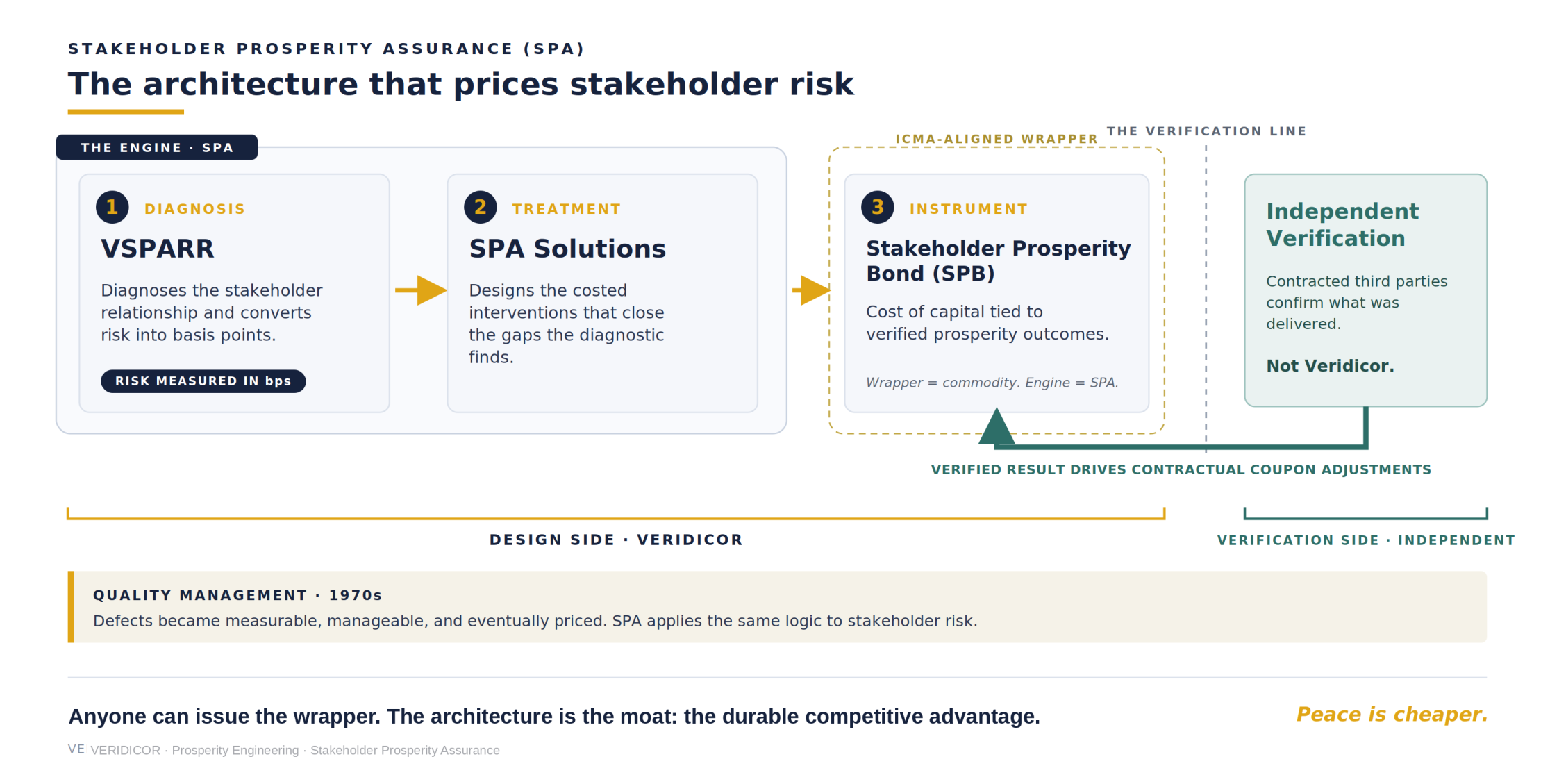
The two valleys hand that reader three questions, and you can test them against every paragraph that follows. Where exactly is the design? Does the money convert? Who has checked? Each question maps to one part of the architecture above, and you will meet the three in order. If you cannot answer all three for an asset, you do not yet have stakeholder assurance. You have exposure. Now the story.
I. The valley with gold, the valley with cacao
Start with the outcome, because the outcome is what a comparison like this is for.
Cajamarca is gold country. Yanacocha, for years the largest gold mine in South America, sits in its highlands, and for three decades the canon minero… the constitutional share of mining revenue returned to the producing region… has poured money into the regional and municipal budgets there. By the standard story, Cajamarca should be prosperous. By the actual numbers, it is the poorest department in Peru. INEI’s latest release, for 2025, puts Cajamarca’s poverty at 41.0 percent, the highest in the country with Loreto close behind at 40.1 percent, against a national rate of 25.7 percent. It has held that position, poorest or near-poorest, in every year on record… its 17th straight year in the country’s highest extreme-poverty group, even as the regional economy grew 7.5 percent in 2025.
One note on how INEI reports this, because it matters for the chart below. The agency publishes a department point estimate… 41.0 percent for Cajamarca in 2025, 45.0 percent in 2024… and, separately, a robust grouped presentation that places statistically similar departments into the same band with a 95 percent interval. The two are not the same number, and I keep them apart. The point estimate is the headline. The grouped intervals are what the chart plots, because those are the figures INEI considers robust to compare across regions.
San Martín is cacao country. It has no canon to speak of, no world-class mine, a fraction of Cajamarca’s mineral wealth. It sits two full groups lower in the same INEI ranking, with recent readings in the low 20s, comfortably below the national rate. It is one of only a handful of Peruvian departments that came out of the pandemic below its pre-2019 poverty level.
Set the two side by side across the 2014 to 2024 grouped series and the gap is not noise. It is structure. INEI publishes department poverty as groups of statistically similar regions, precisely because single-department point estimates carry wide confidence intervals and year-to-year wiggles are often not significant. So here is the cleanest way to say it, in INEI’s own language: across every year in that series, the agency’s grouping never once placed Cajamarca and San Martín in the same band. The poor valley with the gold and the prosperous-by-comparison valley with the trees are never statistically confusable. That is not a number doing the arguing. That is the national statistics office doing it.
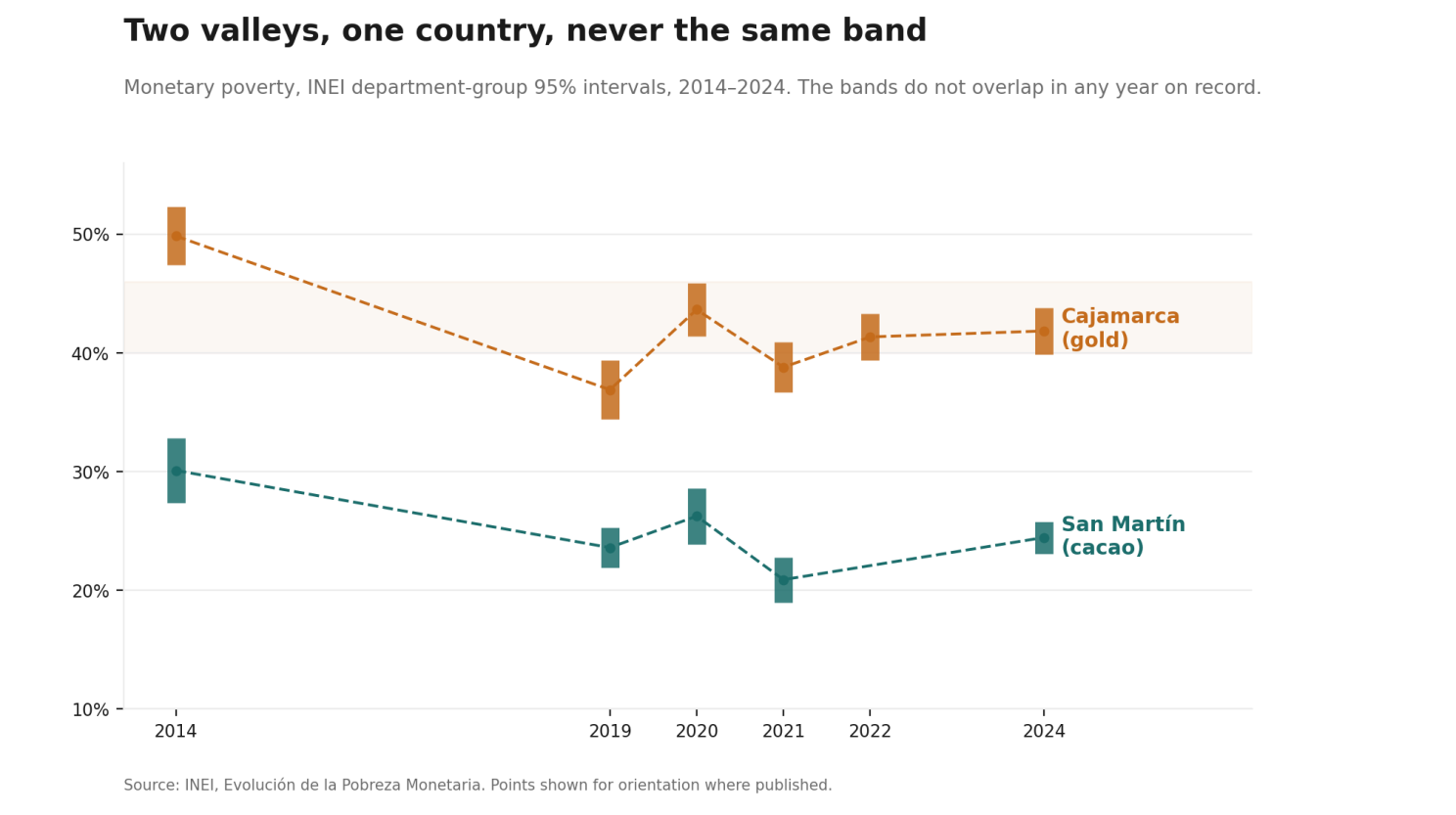
igure 1. Monetary poverty by region, INEI department-group 95% intervals, 2014 to 2024; points shown for orientation where published. The bands do not overlap in any year on record. Source: INEI, Evolución de la Pobreza Monetaria.
None of this means mining caused Cajamarca’s poverty. The highlands were poor before the mine, and rural-highland poverty in Peru is structural and old. The point is narrower, and far more important for capital: the mining revenue did not convert it. Thirty years of canon, one of the largest gold mines on the continent, and the household numbers would not converge. Peru’s 2017 census counted hundreds of thousands of Cajamarca-born citizens living in other regions, a migration fact that sits uneasily beside three decades of mining revenue. The cacao didn’t lift San Martín by itself either, and no honest reading says it did. The cacao is the visible end of a chain that runs security, land titles, cooperatives, roads, and verified markets. What the trees mark is where that chain came out the other side. Hold that image… the chain, not the crop… because it is the thing the gold valley never built.
II. The $20-million-a-week valley
In January, in The $20 Million Per Week Problem, I put a number on what stakeholder rupture costs, and the number was $20 million a week. That is the order of the delay cost a stalled large mine carries while it sits idle. I argued then that stakeholder conflict had become the dominant driver of value destruction in mining, that conflict-exposed miners can trade at deep discounts, and that the documented destruction across a handful of names… Cobre Panama, Panguna, Las Bambas, and the rest… already ran past $50 billion. The piece made one claim above all: stakeholder risk is not a social issue. It is credit. The two valleys are where that claim stops being an argument and becomes a balance sheet.
Take the catastrophic version first. On the morning of November 28, 2023, Panama’s Supreme Court ruled the contract governing Cobre Panama unconstitutional, and one of the largest copper mines on Earth went dark. First Quantum placed a roughly $10 billion asset, the largest private investment in the country’s history, into what it politely calls preservation and safe management. The lights are on, the gates are locked, nothing is mined. First Quantum reported a net loss of $954 million for 2023, with $1.45 billion in the fourth quarter alone. Franco-Nevada wrote its interest down by $1.169 billion. The stock fell from around $40 Canadian in mid-2023 to roughly $11 by December, near 70 percent. And the sovereign took it too: Fitch cut Panama to BB-plus from BBB-minus on March 28, 2024, ending an investment-grade rating the country had held since 2010, citing a closure worth about 5 percent of GDP and 7 percent of external receipts.
Copper prices were fine the whole time. This was a stakeholder event that became a credit event, because the relationship between the asset and the people around it was never something capital could read independently. The orebody was engineered brilliantly. The compliance was engineered. Nobody engineered the prosperity. Consider what that single asset is worth now: about $10 billion in stranded book value at First Quantum, a $1.17 billion stream impairment at Franco-Nevada, a $20 billion damages claim in First Quantum’s now-suspended arbitration, $5 billion in Franco-Nevada’s, and constitutional zero in the court’s ruling. One mine, five valuations, and no independent layer to settle them.
Now bring it home to the gold valley, because Cajamarca has its own version, and it is the cleaner case. In 2011 and 2012, Newmont’s Conga project, a roughly $4.8 billion expansion of the Yanacocha system with about $1 billion already in the ground, ran into a wall of opposition over its handling of high-country lakes and water. The protests escalated, a state of emergency followed, and over three days in early July 2012 five people were killed in Celendín and Bambamarca. Conga was suspended, and it was eventually written down and removed from the pipeline. A $4.8 billion project in the richest mining department in Peru, about a billion already spent, never built. The canon kept flowing. The poverty rate stayed at the top of the national table.
Conga is the $20-million-a-week problem and it is the slow version of Cajamarca’s whole story at once. The operator held its permits. It had run its consultations and filed its studies. None of that converted into the one thing that keeps a 20-year asset alive on a 3-year political cycle, which is a population that experiences the project as prosperity rather than as extraction. Compliance is not continuity. An operator can meet every statutory requirement and still watch the asset stop, because the market that actually decides whether a mine runs is the human one around it, and that market was pricing something the permits never measured.
III. Cacao beat coca
I am not a neutral observer of San Martín, and the honest thing is to say so at the front, because undisclosed it would be a weakness and disclosed it is the strongest thing I can offer you. I was inside the machinery that helped run it.
I spent 24 years at USAID running development portfolios in hard places… Afghanistan, Peru, Colombia, Sudan, South Africa… and five years before that as a food broker moving product across the United States, Chile, and Japan, which is where I learned that a supply chain is a relationship with a price on it. For a long stretch of that career I was inside the effort that built the legal economy of the Huallaga valley, of which San Martín is the heart. When I first worked there, the region was known for coca, trafficking, and the remnants of Shining Path. The prevailing assumption was that security would solve the problem. Security mattered. It was not enough.
Over the following years a coordinated effort… United States and Peruvian agencies, regional and local governments, cooperatives, and thousands of farming families… built a legal economy around cacao, coffee, roads, and market access. During that period, Peru’s cacao industry grew from something like $50 million to more than $1 billion, with USAID and its Peruvian partners helping build part of the legal value-chain foundation. Cooperatives that had started with a few dozen members grew into thousands. Poverty fell. Cacao and coffee replaced coca across large parts of the region.
And the household numbers moved first. The United Nations’ own case study of what it calls the San Martín model puts it plainly: between 2001 and 2010, the region’s poverty rate fell from 70 percent to 31 percent, nearly forty points, the steepest sustained decline of any department in Peru… in 2010 alone it fell thirteen points, the largest single-year drop in the country. That is the older INEI series, so keep it apart from the charts below; the direction needs no methodology note. The valley was converting.
Then, in February 2012, the war in the Huallaga ended the way these wars actually end. Florindo Flores Hala, known as Artemio, the last Shining Path commander in the valley, was shot by one of his own men… a follower turned police collaborator, moved by a five-million-dollar United States reward and by the fact that the future around him no longer required his protection. Artemio escaped wounded, kept alive on an IV line by two kidnapped paramedics, and on February 12 a patrol found him in a hut near the caserío of Pizana, in the district of Pólvora, province of Tocache… the same province as the bar that opened this Letter. The two men still with him fled. He was taken alive, alone, his right arm all but gone.
I know that district, because I helped fund it. In the final push we placed fifteen million dollars of USAID money into Bolsón de Cuchara, one of the last coca pockets that sheltered him, and the message that traveled with the money was not subtle: the legal economy pays, and it pays people who no longer need him. An insurgency does not end when the commander is captured. It ends when no one will hide him. And by February 2012 the population that had fed him, hidden him, and warned him for thirty years had, family by family, cooperative by cooperative, switched sides to a crop with a wrapper.
Five months later and six hundred kilometers west, five people were killed in Celendín and Bambamarca, and a $4.8 billion gold project stopped forever. Same country. Same year. One valley ended a thirty-year war because prosperity had arrived. The other lost its flagship project because prosperity never had. 2012 is the year the two valleys crossed, and the rest of this Letter is the mechanics of that crossing.
The lesson was never that cacao defeated terrorism. The lesson was that prosperity changed the incentive structure. Security created the space. Prosperity filled it. I have never forgotten it, and it is the reason I treat stakeholder prosperity as infrastructure rather than philanthropy. That was the first victory, and it is the one most people stop at. Cacao beat coca. The harder and more interesting victory is the second one, and it is the reason this Letter exists.
IV. The money was never the difference
The obvious explanation for the gap between the two valleys is money: Cajamarca was starved, San Martín was showered. The obvious explanation is wrong, and it is wrong in a direction that should make a capital allocator sit up.
Peruvian and donor money shaped both valleys. The state that wrote Cajamarca’s canon checks is the same state that funded much of San Martín’s reconstruction, alongside the donors I worked for. Peru’s own development agency, DEVIDA, grew its alternative-development budget from about $15 million in 2011 to $38 million by 2019. USAID’s flagship cacao program of the later years, the Peru Cocoa Alliance, committed $36 million and leveraged $49 million in private co-investment.
Real money, catalytically placed. And catalytic is the precise word: the UN’s accounting of the San Martín model counts roughly $2.1 billion invested in the region between 2003 and 2011… 79 percent of it Peruvian state money, 20 percent private, and one percent international cooperation. One percent bought the design. But set it against the canon flowing into Cajamarca and the conclusion is unavoidable: if anything, the gold valley got more.
And it still does. Pull the regional government’s investment budget from Peru’s own transparency portal and the picture is stark. Cajamarca’s modified investment budget for projects has run consistently larger than San Martín’s, roughly 60 percent larger in recent years, climbing on mining canon to nearly 1 billion soles by 2024 against San Martín’s 600 million. The poorer valley had the bigger budget. Say that sentence twice, because it is the thesis compressed to one line. The region with double the poverty was working with more money, not less.
Here the second of my prior Letters comes due. In The $50 Billion Vacuum, two months ago, I wrote that official development assistance fell 23 percent in 2025, the largest annual contraction on record, with the United States cutting more than half its aid and the five largest donors cutting at once for the first time. For twenty years that aid was an implicit contract. Governments funded the conditions that made private investment viable… the schools, clinics, roads, and agricultural systems that kept communities stable enough for mines to operate and bonds to close. That money helped create the conditions the cacao valley grew out of… it never worked alone, and it took two decades of continuity across governments, donors, cooperatives, and thousands of farming families to compound. The same kind of money is exactly what just disappeared.
So the two valleys carry a warning the development-finance world has not absorbed. San Martín’s conversion was financed by an aid system that no longer exists. The buffer that made the cacao miracle possible is gone, and the risk it used to absorb has not vanished. It has moved… onto operators, onto lenders, onto insurers, onto balance sheets that were never built to price it. Which means the converting work that separated the two valleys can no longer wait on a donor. It has to be financed by capital markets directly, or it does not get financed at all. Hold that thought. It is where this whole series is going.
V. The execution gap, and why closing it was not enough
The first place the two valleys diverge is in whether the money moves at all. Peru’s budget system has a brutally simple measure for this. Take a region’s modified investment budget for the year, the PIM. Take what it actually spent, the devengado. The ratio is the avance, the execution rate, and it is the share of investment money the regional government turned from a line in a budget into a contract, a project, a thing that exists.
You have to be careful here, because total spending execution flatters everyone. Payroll always executes near 100 percent. To see whether a region can actually build, you strip payroll out and look at investment projects only. When you do that for the regional governments of the two valleys, the gap is wide and durable.
One honest caveat on the measure. This is not a full canon-flow audit, and it does not trace every sol of mining revenue from the treasury to a finished school. It is a clean capability proxy: regional-government project execution, stripped to Solo Proyectos in Peru’s own budget portal. It answers one question well… could the regional government turn appropriated investment money into built projects… and that capability is exactly what the execution gap names. Different filters move the level a few points, and a published ComexPeru summary of 2024 reads a little higher than my own pull. The direction and the gap are identical.
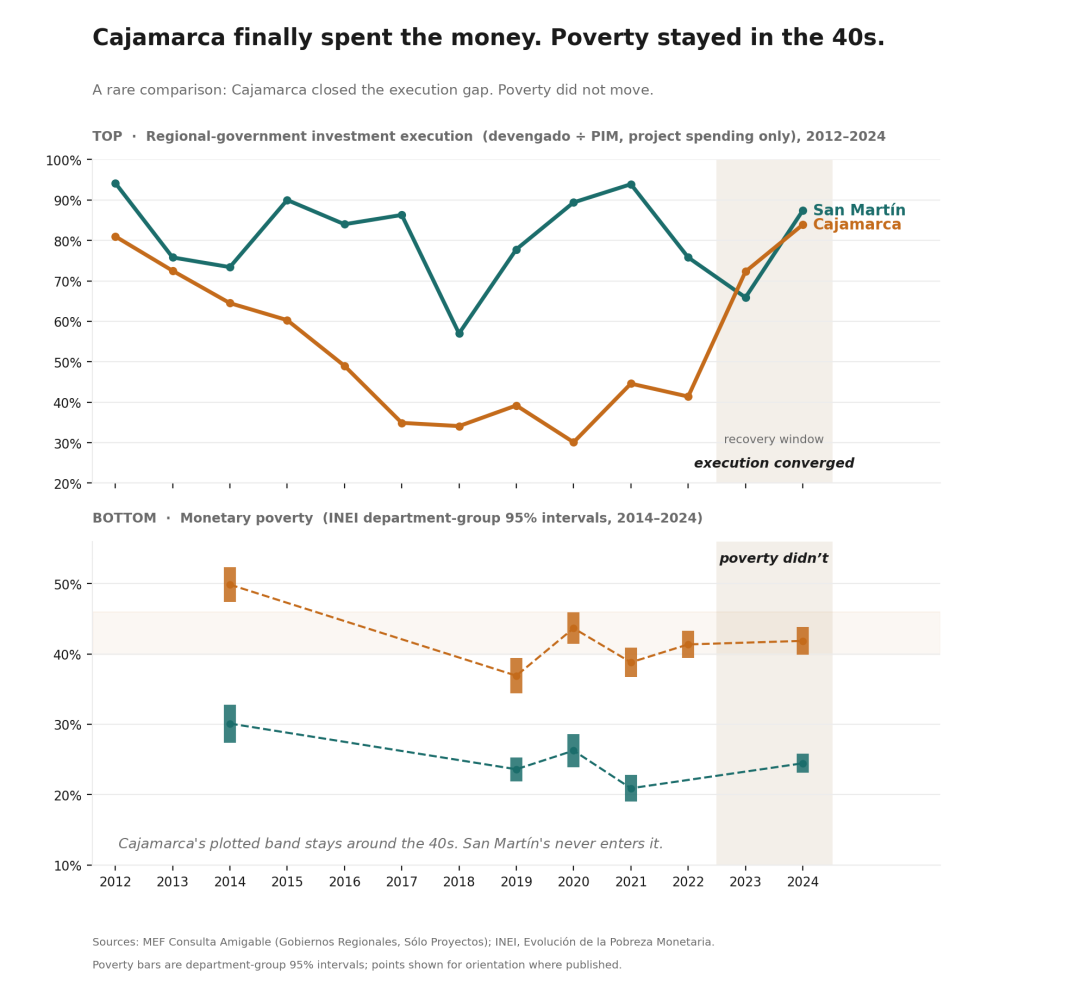
Figure 2. Top: regional-government investment execution (devengado ÷ PIM, project spending only), 2012 to 2024. Bottom: monetary poverty, INEI department-group 95% intervals, 2014 to 2024; points shown for orientation where published. Cajamarca’s execution recovers sharply in 2023 to 2024 and it remains Peru’s highest-poverty department. Sources: MEF Consulta Amigable; INEI.
From 2016 through 2022, San Martín’s regional government executed its investment budget at roughly 80 percent. Cajamarca’s ran in the 30s and 40s. In some years the gap was enormous: in 2020, San Martín executed about 89 percent and Cajamarca about 30 percent. Across 2016 to 2024 San Martín executed better in eight of nine years, and back to 2009 it is fifteen of sixteen. Cajamarca, sitting on the larger budget, could not turn it into built things. That failure mode earns the one brick this Letter sets down: the execution gap, the distance between money appropriated and money converted. It is the first thing that separates a region that assumes prosperity from one that produces it.
Now the part I will not crop, because cropping it would be the dishonest move and a sharp reader pulls the same data I did.
In 2023 and 2024, Cajamarca closed the execution gap. Its investment execution climbed from the low 70s in 2023 to the mid-80s in 2024, right up alongside San Martín. The money finally moved. And Cajamarca stayed the poorest department in Peru. Its poverty did fall the next year, to 41.0 percent in 2025, but in line with a nationwide decline that took the country from 27.6 to 25.7 percent, and Cajamarca remained the highest-poverty department in the country, with Loreto close behind, roughly 15 points above the national rate and close to 20 above San Martín. Recovered execution did not close the gap.
Read that carefully, because it is the most important thing in the whole dataset. Closing the execution gap was necessary. The data do not show that it was sufficient. Cajamarca learned to spend the money and remained, with the gold and the canon and the bigger budget, the poorest department in Peru. Two years is too short to prove a permanent non-effect, and I am not claiming one. The narrower, harder claim is the one that survives every objection: treasury execution is not a verified conversion metric. It records that money left the treasury. It does not record that anyone’s life changed. Spending is not conversion. And the mechanism is visible in this very dataset.
Cajamarca’s recovered execution became contracts and concrete… but it was spending into a valley with no designed chain for a household to plug into. No titled, organized producer base to absorb a feeder road. No certified value chain to make a warehouse pay. The census migration is the tell: hundreds of thousands of Cajamarquinos plugged into other regions’ economies instead. Spending without a chain converts into infrastructure. It does not convert into income.
Which means the fix that closes the execution gap… call it capability lending, the practice of seconding real engineering and project-management capacity into a regional government so the technical files clear and transfers become roads and clinics… is the first layer of the answer and not the whole of it. It gets the money moving. It does not, by itself, decide whether the money builds the thing that converts. For that you need a layer above execution. You need design.
VI. What converts: SPA Solutions
San Martín, mostly out of desperation, ran a different model from Cajamarca: secure, sequence, design. First the state broke the insurgency and the coca economy’s grip. Then, into the space security created, somebody built a designed, prosperity-producing economy. Farmer cooperatives. Land titling. Certified value chains. Roads to market. Instruments that paid for verified performance instead of for promises. One region assumed prosperity would follow the money by something like gravity. The other designed it. And design never meant a master plan. The model adapted for two decades… security to alternative development, production to market access, commodity to value-added… holding one direction while changing its methods. Design, in this Letter, is not a blueprint. It is a discipline.
That designing work has a name in the framework this series is building, and it is not architecture in the abstract. It is SPA Solutions: development design and implementation. The plain version is the one that matters to anyone who has watched a budget get spent badly. It is the ability to organize money intelligently so that it becomes actual economic development, instead of box-checking. Permits are box-checking, priced as compliance. ESG reports are box-checking, priced as disclosure. Neither converts anything. SPA Solutions is the layer where capital finally buys performance, because somebody designed the chain that produces it and then built the chain. It is a craft, and a scarce one, and I will be candid later about who holds it.
In San Martín the load-bearing institutions are the cooperatives. ACOPAGRO, founded in Juanjui in 1997 with 27 members out of a United Nations program promoting cacao as the coca alternative, grew to roughly 2,000 member families and became one of Peru’s leading organic cacao exporters, with its own fine-chocolate brand, Gran Pajaten. The Cacao Tocache cooperative, whose bar opened this Letter, carries four certifications on every lot it ships. In 2016 it sent its first containers directly to Europe… 15 tons of organic, fair-trade beans bound for the Zotter chocolate factory in Austria… a shipment years in the making, with German cooperation’s Prodatu program and DEVIDA financing the market-prospecting that found the buyer.
The trade consultant who organized that deal told Gestion, Lima’s financial daily, that cacao had become synonymous with progress and social peace in a zone once defined by narcotrafficking. Her words, not mine, in a business newspaper. And none of this floats free of markets: cacao ran to a record near $13,000 a ton in late 2024, collapsed by more than two-thirds into the spring of 2026, and has stayed violently volatile since… trading near $4,000 a ton as June opened and back above $5,000 by early July, still roughly 40 percent below a year earlier. A designed value chain does not make a region immune to price. It makes the region able to survive the swing, because the income is spread across thousands of titled, organized, certified families rather than concentrated in one rent.
This is what beat gold. Not the bean. The chain behind the bean, designed and implemented by people who knew how. Cacao beat coca first. Then the designed legal economy outperformed the gold-revenue model on the only scoreboard that counts for a region: whether its people stopped being poor. And it was never cacao alone. The spine was a set of legal, viable value chains… cacao, coffee, and even palm oil… chosen because each could actually pay a family, then built into roads, schools, clinics, and a regional government that worked well enough to keep them running.
The value-added piece came last and mattered most: cacao becomes chocolate, and the margin that used to leave the country stays in Tocache. And the ceiling of that value-added chain stopped being hypothetical in November 2025, when a Peruvian bar… El Ganso, made by Cacaosuyo from native Junín cacao… was named Overall Winner, the best chocolate in the world, at the International Chocolate Awards world final in Florence, and the maker’s first act was to credit the farmer, Luis Samaniego, by name.
A different region, the same country, the same logic: a designed chain, an anonymized jury, a checked claim, a price that moved. Gold had the higher price per ton, the bigger budget, and the constitutional revenue share. San Martín had the designed chain. The design won. Won as a contribution among many, to be clear, not as a single cause; complex outcomes never have one, and this comparison does not need one. It needs only what the record supports: the money alone did not decide the difference, and the system the money moved through did the deciding.
San Martín’s hands are not clean, and a fairy tale is not forwardable to anyone who knows the place. There is an Odebrecht road in its history, a prosecuted governor, and a palm-oil industry that sits at the center of credible Amazon-deforestation litigation, with tens of thousands of hectares lost nationally. The cacao valley is not Eden. It is a place where a designed economy outperformed an extractive one despite real flaws on both sides. That is a stronger claim than purity, not a weaker one.
VII. The verification line
Readers of this Letter have met its signature before. The Verification Gap I named in April… the structural absence of an independent measurement layer between the moment something is claimed about stakeholder prosperity and the moment capital prices it… is this same gap, seen at instrument scale. The two valleys show it at regional scale, with the time series and the hard comparator attached.
The mechanism is the three states of a prosperity claim. A claim has been made. Or it has been partially verified, usually by the operator. Or it has been independently verified against a public-data baseline. Capital today prices the first state as if it were the third, and the distance between them is the gap. You saw it in January when United Tractors and Astra lost roughly $1 billion in combined market value in a single Jakarta session, not because the assets had become a billion dollars worse, but because the market had no way to verify whether they had become worse at all. The announcement was the only signal available, so the announcement set the price.
The same gap runs through the instrument the market built to price exactly this. In sustainability-linked bonds, capital prices the prosperity claim at issuance: the issuer commits to a KPI, the wrapper carries a coupon step-up if the KPI is missed, and the bond trades on the claim. By 2024 that market had a record, and the record is not good. Issuance had peaked near $115 billion in 2021 and then fell roughly 70 percent. The overwhelming majority of targets were environmental; social targets ran in the single digits, around 8 percent.
Reported miss or off-track rates clustered roughly between 15 and 30 percent, and the penalties clustered around 25 to 31 basis points, far below what changes behavior. For a large issuer that step-up can be a rounding error on total interest expense, a fraction of a percent. Penalties at that level get paid as a cost of doing business and the bonds keep clearing. The broader sustainability bond market now runs past $1 trillion a year, only about 14 percent of it reaches emerging markets, and almost none of it measures whether the people around an asset got better off. The market built the instrument and pointed it at the wrong variable.
The roster of what the gap costs is consistent across very different events. Cobre Panama’s gap closed when the asset went non-priceable, five valuations on one mine and no independent layer to settle them. Martabe’s closed when a January announcement moved the price and then walked back, the discount unwinding by mid-May. Conga’s closed when it was suspended and removed from the pipeline, $4.8 billion planned and about a billion sunk. Pebble’s closed in Alaska when the Army Corps denied the permit in 2020 and a $2.3 billion projected value was never tested. Well over $10 billion in impaired, stranded, suspended, or never-realized value across them, and that is before the wider corridor losses. Different failure modes, the same architectural absence. Not one of them closed because architecture had been built. They closed because contingency held. Until contingency does not.
The industry has never lacked a framework for this problem, and each one deserves its due, because each named something real. Corporate social responsibility named the obligation, and produced spending: dollars out the door, Cajamarca’s two decades of it. ESG named the exposure, and produced disclosure: reports filed, risks tabulated, conduct described. The social license to operate named the fragility, and produced perception: a license with no issuer, no terms, and no register, which Conga held by every legal measure and lost in a single July week. And shared value, the most ambitious of the four, named the prize itself: : Michael Porter’s insight that a company could profit by solving the problems around its assets.
Porter was right. And Shared Value stopped one layer short, because a value no independent party measures is a value the market cannot pay for, and what cannot be paid for does not reliably get produced. Four frameworks, four real insights, one shared absence. Not one of them measures whether the household beside the asset got better off. Not one submits the answer to independent verification. Not one attaches a price. Conduct, disclosure, perception, intention: the two valleys were never separated by any of these. They were separated by verified performance, and by the chain someone engineered to produce it.
Permits get priced as compliance, and Cajamarca’s permits did not convert poverty. Disclosure gets priced as disclosure, and no ESG report ever moved Celendín. Conga held its regulatory record right up to the day it was suspended, a parallel record that ran alongside the prosperity record without ever touching it. What the record shows actually converting is design tied to performance, with performance that someone independent can verify… security that held, titles that registered, cooperatives that shipped, seals that a European buyer trusted enough to pay more for.
That last point is where a price attaches, and it deserves a name, because it is the farm-gate version of a concept this series carries up to bond scale. The premium a verified cooperative earns over an anonymous seller… the few hundred dollars a ton the four seals are worth… is a Verification Premium. In Peace Is Cheaper, my last white paper, I borrowed Philip Crosby, who taught a generation of manufacturers that quality is free because the real expense is the price of nonconformance, the money a firm burns building things wrong. The Verification Premium is that idea turned toward stakeholders. The cacao valley earned the premium for conformance. The gold valley paid the price of nonconformance, in suspended projects and a poverty rate that would not move, and never saw the bill itemized because no instrument itemized it. At the farm gate the premium is dollars per ton.
At the scale this framework is built for, it is basis points on a spread. Same mechanism, different denomination. How many basis points is the fair question, and the honest answer today is a bracket, priced off the two failure modes this Letter has already documented. The floor is what the market currently charges for an unchecked promise: the 25 to 31 basis points of an SLB step-up, a penalty issuers pay as a rounding error. The ceiling is what the event costs when contingency fails: a sovereign downgrade out of investment grade, a 70 percent equity drawdown, an asset priced five ways at once. The verified premium lives between those bounds, and pinning it per asset class is precisely the work a diagnostic exists to do. What the bracket already proves is the mispricing: the market pays single-digit basis points for claims whose failure costs hundreds.
Which brings the cold open back around. A bar of chocolate from Tocache carries four independently verified performance claims, each one moving a price. One of the largest gold operations in Latin America carried permits and audits and reports by the hundred, and not one claim of that kind. Compliance documents describe conduct. The seals on the chocolate price performance. Sit with the asymmetry for a moment.
The world blind-judges its chocolate in Florence, audits the farms annually, and certifies every lot it ships. Nobody, anywhere, has ever certified whether the people beside a ten-billion-dollar mine got better off. The most valuable thing in the ground carries the least verified claim about the people above it. Fifty kilometers from the mine are households in the poorest department in Peru, and the difference between those two wrappers is why.
VIII. The moat behind the moat
A diagnostic is only as credible as the institution that governs it, so let me be direct, including about my own firm. The diagnostic that scores the variables this Letter has been circling… the stakeholder relationship turned into something a market can read before it becomes an event… is VSPARR. It is Veridicor’s, it is proprietary, and it was built out of the same field decades this Letter draws on. What it produces is the only detail a reader here needs: stakeholder risk, denominated in basis points, readable by capital before it becomes an event.
I say that plainly because candor is the point. Veridicor’s authorship is not a weakness to hide. It is where every market-standard analytical framework on Earth began. Moody’s started as one analyst’s judgment on railroad bonds. SASB started as one organization’s standards. The TCFD started as a task force. IRMA started as a coalition. Every one of them began as somebody’s product and earned its way to standard by being right where it mattered.
And here is what the two valleys demonstrate is scarce, whoever ends up holding it. The scarce part is not the diagnostic. It is the design-and-implementation layer… SPA Solutions in this framework’s language… the ability to organize capital into development that actually converts. San Martín shows the capability exists. Cajamarca shows what its absence costs. Neither valley shows it coming out of a textbook; it comes out of decades in corridors like the Huallaga. That is the moat behind the moat.
Anyone can issue the ICMA wrapper. The converting layer is what is hard to copy, and the case, not the firm, is the evidence. This is the same truth Toyota proved against Detroit: the firms that internalized quality early did not just avoid defects, they earned a structural advantage that took competitors decades to close. Stakeholder prosperity is, right now, where quality was in the 1970s. Dismissed by incumbents as soft. Treated by a few as the core of management. About to become table stakes. The only question is who internalizes it before it is priced for everyone.
IX. What this means if you price risk
If you allocate capital to extractive or frontier assets, the two valleys hand you three questions that cost nothing to ask and discriminate brutally between assets.
First, where exactly is the design? Not the social-investment budget, which is an input. Not the impact report, which is a disclosure. The design: the sequence, the owners, the instruments that pay for verified performance. If the answer is a spending figure and a glossy report, you are looking at Cajamarca, however large the figure.
Second, does the money convert? Ask for execution, then ask the harder question Cajamarca answers: even where it spends, does the spending move the outcome? An operator or a region that can point to spending but not to converted, verified prosperity is carrying an unpriced risk, and the spread is paying for it whether anyone has named it or not.
Third, who has checked? Every prosperity claim sits in one of three states. Claimed. Partially verified, usually by the operator. Or independently verified against a public baseline. Capital today prices the first as if it were the third. That distance is the Verification Gap, the most expensive unnamed line item in resource finance. It has a name now, and a price, and a place it has already been measured: two valleys in northern Peru.
And if you underwrite rather than lend, the same gap is already sitting under your book. Berne Union members carry roughly $2.5 trillion in cross-border payment risk protection a year. Most of that is commercial credit risk, but the political-risk-insurance slice is the part most exposed to stakeholder-driven asset survivability, and it is priced today on consultant reports, country indices, and proprietary scores that work around the verification gap rather than closing it. The same architectural absence that took 5 percent of Panama’s GDP offline overnight is sitting underneath the underwriting math on the segment of the book that most needs it closed. An insurer does not need the bond to exist to want this. It needs better data than a country index, and the data is the same data the bond would run on.
X. Four numbers, one valley
It is worth standing back, because everything I have argued since January converges in Cajamarca, and the convergence is the point.
The $20 million a week is there, in Conga: a $5 billion project the operator was legally entitled to build, stopped by a population that experienced it as extraction, while the canon kept flowing and nothing converted. The $50 billion vacuum is there, in San Martín: the aid that helped build the cacao economy is the aid that just collapsed, which means the converting work now has to be financed by capital or not at all. The Verification Gap is there, in both valleys at once: permits and reports that priced conduct, against seals and titles and cooperatives that priced performance. And the price of peace is there, at the farm gate, in the few hundred dollars a ton that a checked claim earns over an unchecked one.
Four Letters, four numbers, and they all land in the same place. That is not coincidence. It is what it looks like when a single missing instrument shows up from four directions. The instrument is a way to measure stakeholder prosperity the way the market eventually prices it, to design the chain that produces it, and to bind capital to verified delivery rather than to the claim of delivery. The diagnostic is VSPARR. The converting layer is SPA Solutions. The bond that carries it, now that the aid is gone, is the work of the Letters still to come. Finance at its best has always been a peace technology, from the Hanseatic League to Lloyd’s to Bretton Woods. This is a restoration of that function, not an invention of it.
Cajamarca got the gold, the canon, and eventually the execution. It is the poorest department in Peru. San Martín got security, then design, then markets that paid for performance someone could verify. It decoupled from the country’s poverty and never looked back. The state spent on both. Only one of them organized the spending into development.
The money was never the difference. The design was. And design, in the sense this Letter means it, has a name: SPA Solutions, the layer that turns resource wealth into the thing wealth was supposed to buy. Cacao beat coca. Then it beat gold. Then Peru beat the world. It was never the crop.
XI. The next valley is golden
I have written about the two valleys as history, and that is not quite honest, because Peru is about to run the experiment again, at seven times the size.
Illegal gold is now the largest criminal economy in Peru. In July 2025 the country’s own foreign minister put it at seven times the size of the cocaine trade. Illicit gold exports reached an estimated $6.8 billion in 2024, up 41 percent in a single year, with Peruvian economists projecting as much as $12 billion for 2025… roughly 44 percent of all the illegal gold in South America and, by the financial intelligence unit’s accounting, 60 percent of everything laundered in Peru over the past decade.
In May 2025, thirteen mine workers were massacred in a shaft in Pataz. The registry built to formalize small miners has become a shield for the opposite. And the networks running the pits are the networks that run the coca… the reporters call it narco-minería… same routes, same logistics, same territorial logic. Gold above $3,000 an ounce is the new coca at its peak, except easier, because cocaine is illegal at every step of its life, while illegal gold, once melted, is indistinguishable from the legal kind. It is the perfect criminal commodity, because it has no wrapper.
Read that sentence against everything above it. The problem with illegal gold is a verification problem. And the country facing it is the only country on Earth that has already converted an illicit commodity economy into a legal, verified, premium-earning one at regional scale… in the same river system, within living memory, with the case study written by the United Nations and the product now judged the best in the world. The playbook is not theoretical and it is not foreign. Secure the space. Design the chain: titles, cooperatives, processing, roads, markets.
Verify the performance, so that a buyer three continents away pays more for the checked claim than for the unchecked one. Certified artisanal-gold standards already exist and already pay a premium per gram, exactly as the four seals pay per ton of cacao. What has never been built is the layer this series is building: the prosperity-engineering layer that lets capital finance the conversion directly, at size, now that the aid system that financed San Martín’s is gone.
Cacao beat coca in the Huallaga. The question of the next decade is whether design can beat gold in Pataz and Madre de Dios. Peru has done this before. It is the only country that has. The lesson is on the wrapper.
Security created the space. Design filled it. Verification priced it.
Peace is cheaper.
Sources
Poverty: INEI, Perú: Evolución de la Pobreza Monetaria. Headline figures are 2025 point estimates: national 25.7%, Cajamarca 41.0%, Loreto 40.1%; charts plot the 2014 to 2024 department-group 95% intervals. Execution: MEF, Consulta Amigable (Mensual), Gobiernos Regionales, project spending only (Solo Proyectos); avance = devengado ÷ PIM; figures rounded, cross-checked against ComexPerú’s 2024 execution summary. Cobre Panamá: First Quantum and Franco-Nevada filings; Fitch sovereign action, 28 March 2024. Conga: Newmont disclosures; contemporaneous reporting of the July 2012 events in Celendín and Bambamarca. Prior Letters: The $20 Million Per Week Problem; The $50 Billion Vacuum; The Verification Gap; Peace Is Cheaper. Alternative development: DEVIDA budget records; USAID Peru Cocoa Alliance. Cooperatives: ACOPAGRO; Cacao Tocache; Gestión. El Ganso: International Chocolate Awards, World Final 2025 results, Cacaosuyo, Junín origin, Best in Competition Overall Winner. Sustainability-linked bonds: OECD capital-markets reporting and published SLB market reviews. Cacao price: ICE cocoa futures. Cajamarca out-migration: Peru’s 2017 national census, INEI. San Martín model: UNODC/DEVIDA/Gobierno Regional de San Martín, El Modelo de Desarrollo Alternativo de la Región San Martín. Artemio: contemporaneous reporting of the February 2012 capture, including IDL-Reporteros, Perú21, Correo, and the U.S. Narcotics Rewards Program offer. Illegal gold: Instituto Peruano de Economía export estimates 2024–2025; Peru Foreign Ministry statements, July 2025; UIF-Perú laundering data; contemporaneous reporting of the May 2025 Pataz killings and the Reinfo registry.
linkedin article